Technical Guide
Bidirectional Charging (V2H): Your Car as a Batería doméstica
Everything about Vehicle-to-Home technology. Which EVs support V2H, what does it cost, and how does it compare to a fixed batería doméstica?
Patrick2 de marzo de 202610 min. de lectura
Back to blog
Iniciar test
What is bidirectional charging (V2H)?
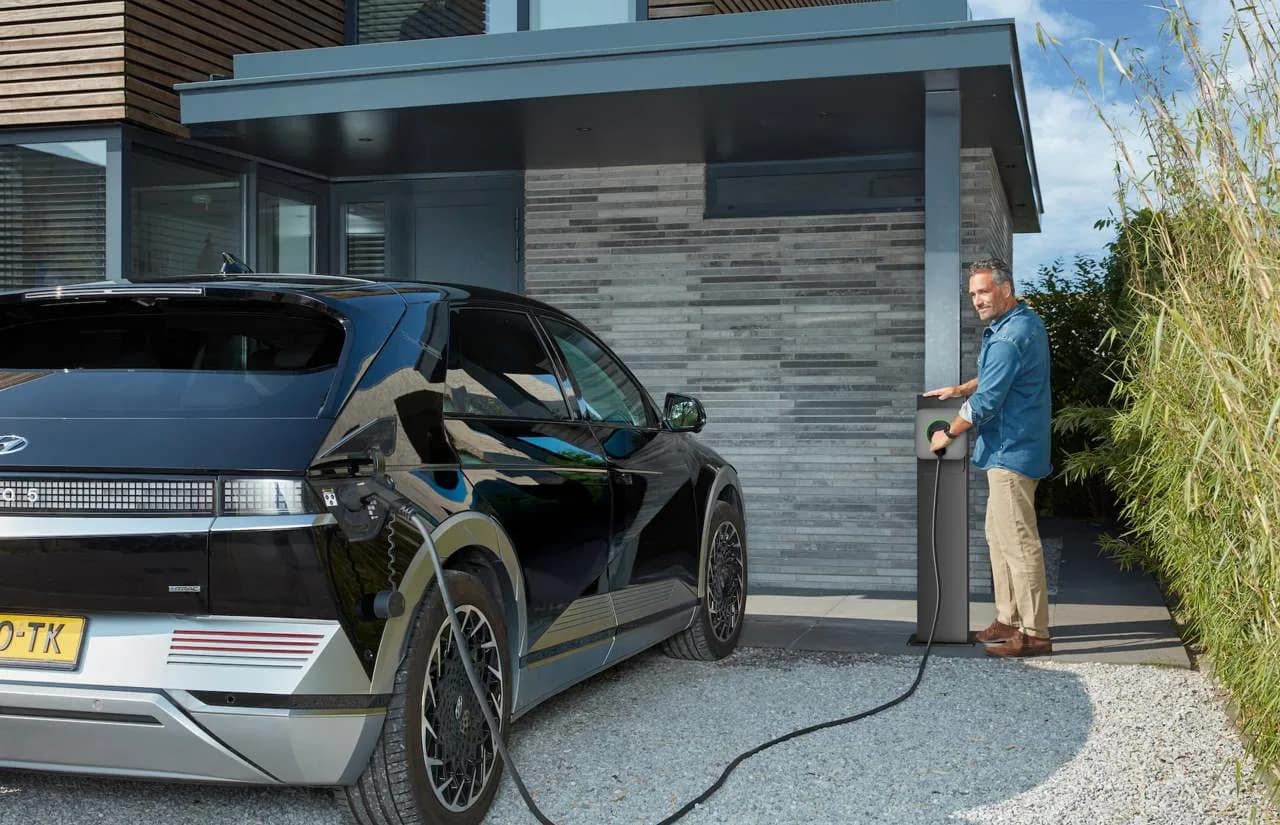
With bidirectional charging, your coche eléctrico can not only absorb electricity, but also feed it back to your home. This is called Vehicle-to-Home (V2H). Your EV battery of 40–100 kWh effectively becomes a massive batería doméstica — many times larger than a fixed batería doméstica of 5–15 kWh. The concept is simple: charge your car during the day with solar power and use that electricity in the evening to power your home.
V2H is becoming increasingly practical in 2026 thanks to more compatible cars, more affordable bidirectional chargers and improved EU regulations. However, there are important caveats — your car is not always at home, and the additional charge ciclos affect the battery's vida útil.
Which coche eléctricos support V2H?
Not every EV can charge bidirectionally. The car must contain specific hardware, and the manufacturer must enable V2H functionality via software. In 2026, the following models support V2H:
- Nissan Leaf/Ariya — pioneer in V2H via the CHAdeMO protocol
- Hyundai Ioniq 5/6 — V2H via CCS with 3.6 kW output
- Kia EV6/EV9 — V2H via CCS, up to 3.6 kW feed-back
- BYD Atto 3, Seal, Dolphin — V2H available in some markets
- Volkswagen ID.4/ID.5 — V2H via software update expected in 2026
Which chargers do you need?
For V2H, you need a special bidirectional charger. A standard wallbox (AC charger) only works in one direction. Bidirectional chargers operate on DC (direct current) and cost considerably more:
| Brand/Model | Protocol | V2H output | Availability NL |
|---|---|---|---|
| Nissan Leaf (40/62 kWh) | CHAdeMO | 6 kW | Available now |
| Hyundai Ioniq 5 | CCS | 3.6 kW | Available now |
| Kia EV6 | CCS | 3.6 kW | Available now |
| BYD Atto 3 | CCS | 3.3 kW | Limited |
¿Qué batería doméstica te conviene?
Haz el test gratuito y descúbrelo en 2 minutos.
Please note: the bidirectional charger must be compatible with your car and your home installation. Not every combination works. Always seek advice from a instalador certificado.
Pros and cons of V2H
V2H has clear pros and cons compared to a fixed batería doméstica:
- Enormous capacidad de almacenamiento: an EV battery of 60 kWh is 4–12x larger than an average batería doméstica
- Dual use: your battery serves as both driving range and home storage
- Emergency power: during a corte de energía, your car can power the entire home for days
- Leveraging an existing investment: you have already paid for the battery as part of the car
- Car not always at home: when you drive to work, your "batería doméstica" is gone
- Additional degradación de la batería: each V2H cycle counts as a charge cycle and shortens battery vida útil
- Expensive bidirectional charger: €3,000–6,000 for the charger alone
- Limited compatibility: not every car and not every charger work together
V2H vs. a fixed batería doméstica: an honest comparison
The key question: is V2H a good alternative to a fixed batería doméstica? That depends on your situation. Here is an honest comparison:
| Criterion | V2H (car as batería doméstica) | Fixed batería doméstica |
|---|---|---|
| Capacity | 40–100 kWh | 5–20 kWh |
| Availability | Only when the car is at home | Available 24/7 |
| Vida útil impact | Additional degradación de la batería | No impact on other devices |
| Cost (charger/battery) | €3,000–6,000 | €1,500–8,000 (5–20 kWh) |
The conclusion is nuanced: V2H offers enormous capacidad de almacenamiento, but a fixed batería doméstica is more reliable and always available. The ideal situation? Both: a batería doméstica for daily storage and V2H as an additional buffer for peak consumption or emergency power.
Costs and payback period of V2H
The costs for a V2H installation are still considerable in 2026. The bidirectional charger costs €3,000–6,000 including installation. On top of that, your car must be compatible — and those cars are often more expensive than models without V2H support.
The payback period for V2H alone (excluding the car itself) is 8–12 years, assuming you have the car at home daily and actively use V2H. By comparison: a fixed batería doméstica of 10 kWh has a payback period of 5–8 years and is much simpler to install.
Conclusion: V2H as a supplement, not a replacement
V2H is a promising technology that will become increasingly accessible in the coming years. But in 2026, for most hogares it is still not a replacement for a fixed batería doméstica. The reasons: higher costs, dependence on car availability, limited model compatibility and additional degradación de la batería.
Our recommendation: invest now in a fixed batería doméstica for daily almacenamiento de energía. Once V2H chargers become cheaper and more cars support the technology, you can add V2H as a supplement. At Home Energy Solutions, we are happy to advise you on the optimal storage for your situation.
A batería doméstica as a reliable foundation?
A fixed batería doméstica is available 24/7 and offers the most reliable storage. Ver nuestra range.
Related Articles
Continue reading about home energy
¿Listo para pedir?
Explora nuestra gama completa de baterías domésticas con la mejor relación calidad-precio.