Seasonal Guide
Home Battery in Winter: Tips for Maximum Performance
How does your home battery perform in winter? Discover the impact of cold on LFP and NMC, placement tips and seasonal optimisation for maximum performance.
Patrick2 March 20268 min read
Back to blogStart quiz
Does a home battery perform worse in winter?
Yes, low temperatures affect the performance of every lithium-ion battery. The chemical reactions in the cells slow down in cold conditions, causing both the available capacity and the charge/discharge power to temporarily decrease. But the impact is smaller than many people think — and with the right measures you can minimise the effect.
The good news: in the Netherlands, the outdoor temperature rarely drops below -5°C for extended periods. And most home batteries are installed indoors, where temperatures stay above 5°C. Modern batteries also have built-in heating elements that activate automatically when temperatures get too low.
Impact of cold on LFP vs NMC batteries
The type of battery chemistry determines how significant the winter impact is. The two most commonly used types in home batteries — LFP and NMC — react differently to cold:
LFP batteries in the cold
LFP cells (LiFePO4) are more sensitive to cold than NMC. At 0°C you lose approximately 10-15% capacity, at -10°C this can rise to 25-30%. Importantly: this capacity loss is temporary. As soon as the temperature rises, full capacity returns. The lifespan of the cells is not affected by cold.
NMC batteries in the cold
NMC cells perform slightly better in cold conditions. At 0°C the capacity loss is 5-10%, at -10°C approximately 15-20%. NMC has higher ion mobility at low temperatures. However, this advantage does not outweigh the other drawbacks of NMC for home use (shorter lifespan, lower safety).
Placement tips for optimal winter performance
Which home battery suits you?
Take our free quiz and find out in 2 minutes.
The placement of your home battery is the most important factor for winter performance. With the right location you can prevent virtually all cold-related performance losses:
- Always place the battery frost-free: a heated garage, utility room or technical room is ideal. The optimal operating temperature is 15-25°C.
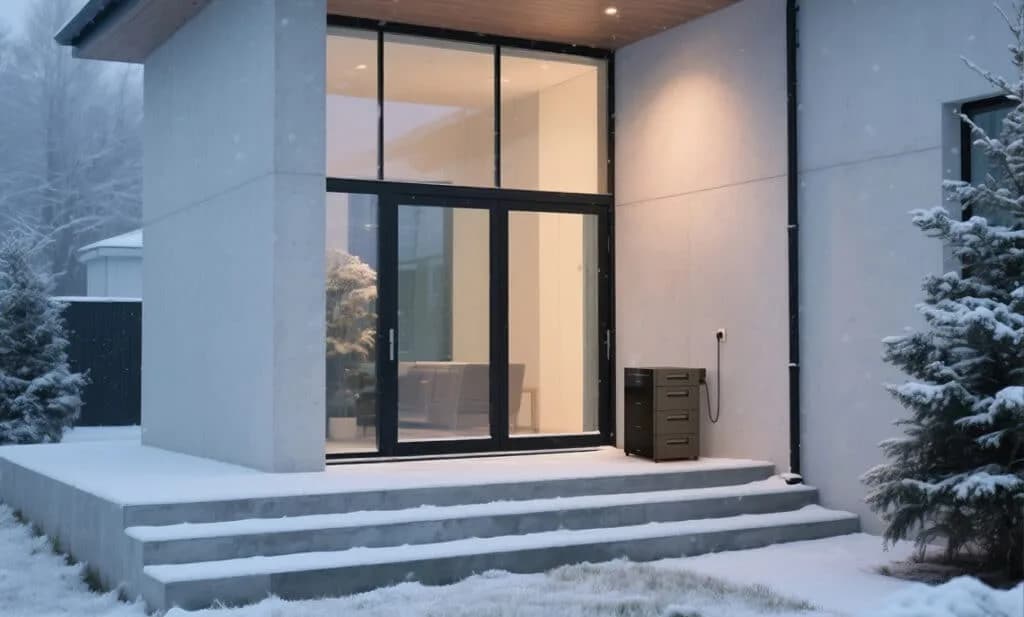
- Avoid unheated sheds and outdoor installation unless your battery is IP65-certified énd has active cell heating (e.g. EcoFlow DELTA Pro Ultra Outdoor).
- Insulate the area around the battery: even an unheated garage can be partially insulated with 5 cm polystyrene boards behind and beside the battery.
- Keep ventilation openings clear: insulate yes, make airtight no. Batteries need air circulation for cooling and heat dissipation.
- Check the firmware: make sure you have the latest firmware update installed. Manufacturers regularly improve winter management.
Winter performance by battery brand
Besides placement, you can also get more from your battery during the winter months through settings and usage patterns:
| Brand/Model | Min. operating temperature | Winter protection |
|---|---|---|
| Anker SOLIX X1 | -10°C to +45°C | Active cell heating, winter mode |
| Anker Solarbank 2 Pro | -20°C to +55°C | Built-in heating, outdoor installation possible |
| BYD HVS/HVM | -10°C to +50°C | Active thermal regulation |
As you can see, the popular brands have given careful thought to winter performance. The Anker SOLIX X1 and BYD HVS score best thanks to active cell heating. Plug-and-play systems like the Solarbank also perform well as long as they are kept frost-free.
Seasonal optimisation: get more from your battery in winter
In winter it is especially interesting to combine a dynamic energy contract with your home battery. Electricity prices fluctuate more strongly in winter than in summer: at night and on sunny afternoons electricity can be cheap or even free, while the price rises significantly around 17:00-20:00.
- Lower the minimum threshold: set the minimum state of charge (SoC) to 15-20% instead of 10%. This protects the cells in cold conditions.
- Charge more slowly: at temperatures below 5°C it is better to charge at a lower power level. Most batteries do this automatically.
- Use the timer function: programme the battery to charge at night during cheap grid tariffs and discharge during the day for your own use.
- Combine with a dynamic contract: in winter, electricity prices fluctuate more strongly, offering additional savings opportunities.
Dynamic tariffs: extra savings in winter
A home battery still performs excellently in the Dutch winter, provided you place it in the right location. The temporary capacity loss in cold conditions (10-15% with indoor placement) does not outweigh the benefits: it is precisely in winter that you save the most, because you need more electricity from the grid and dynamic tariffs show larger peaks.
Furthermore, winter is the period when the net metering scheme is least valuable — you hardly export any electricity back to the grid in winter. A battery helps you make the most of the scarce winter sun and take advantage of cheap night-time electricity rates.
Conclusion: a home battery is valuable in winter too
A home battery is not a summer product — it is a year-round system that adds value in every season. In winter you save primarily by taking advantage of dynamic tariffs and charging cheaply at night. In summer you maximise your self-consumption of solar power.
At Home Energy Solutions we advise you on the best placement and the ideal system for your situation. Get in touch for a free consultation.
Need a winter-ready home battery?
All home batteries at HES are suitable for the Dutch climate. Ask for advice on the best placement.
Related Articles
Continue reading about home energy
Ready to order?
Browse our complete range of home batteries with the best value for money.